
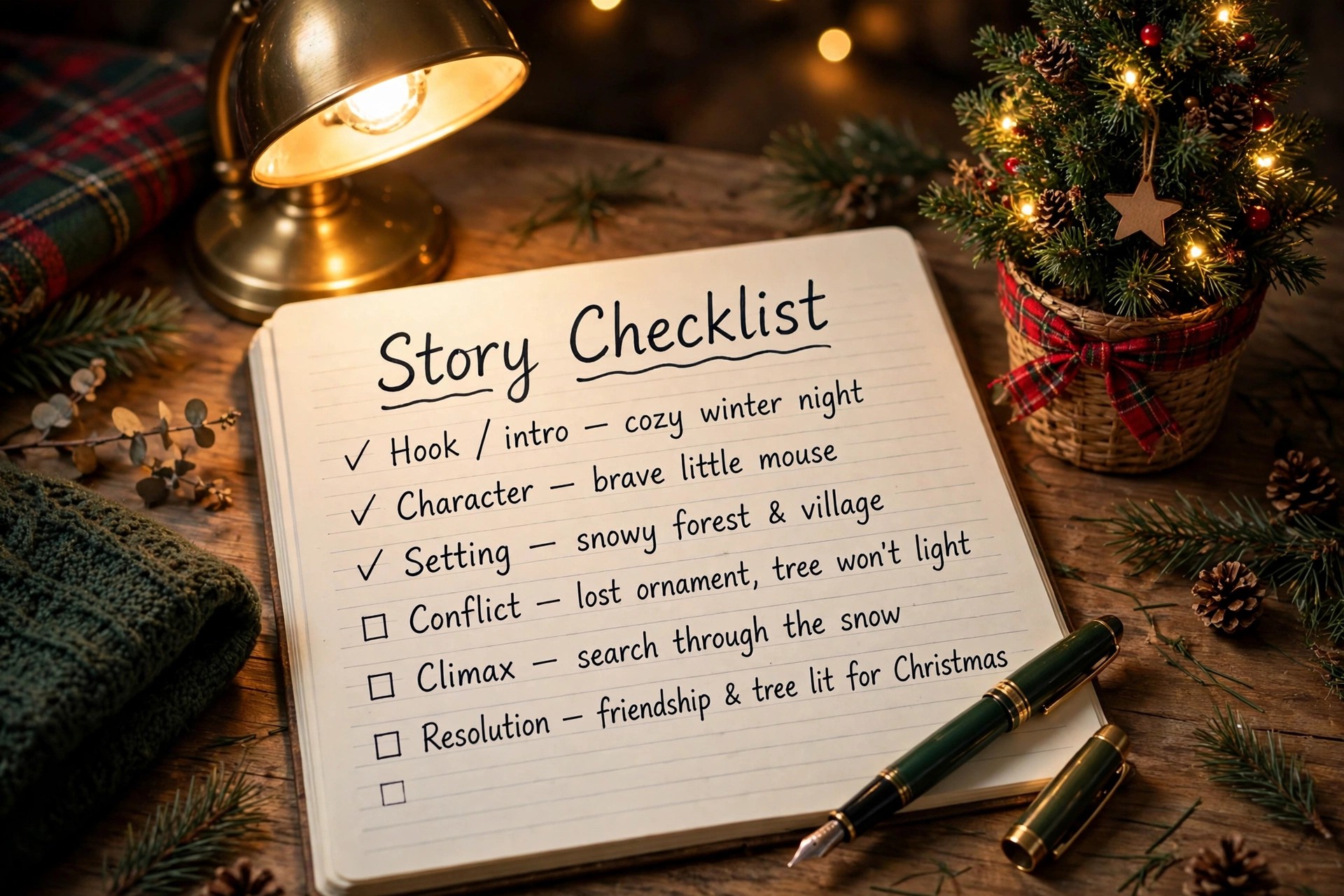
Every December the same list appears on the fridge. Names, gift ideas, prices, check marks. Nobody writes a story that way, but maybe they should. Before you buy a single gift for the writer in your life, or sit down to write the story you have been carrying since summer, make the list that matters: what the story wants, what it needs, and what the take has to prove first.
A take is the shaping pass. It tests your raw idea against the craft before a single scene is written. Does it have a hero worth following? Does it have a problem big enough to carry 90 pages? Does the ending earn the beginning? The take answers those questions early, while they are still cheap to fix.
What goes on the list first?
The want. Not the plot, not the twist, not the clever opening line. The want. A character who wants something clear, who has to choose, who pays a price for that choice, will pull a story forward even when the plot takes a strange turn. Everything else on the list serves that one line.
Most stalled stories are not missing talent. They are missing a want strong enough to carry the middle. Writers blame themselves when the story runs out of road around page 40, but the road was never built. The list was never made. A take builds it before you spend weeks writing scenes that lead nowhere.
How does a take test the list?
It runs your idea through the checks a working screenwriter runs on every scene. Matt Allen spent 25 years in the Writers Guild of America learning those checks: 13 editorial points and 32 governing rules, the craft behind Four Christmases and Soul Surfer. The take reads your idea and shows you where it holds and where it sags, while the fix still costs an afternoon instead of a month.
If you had the time, this is the holiday movie you would write. The take is how you find the time: it tells you which scenes earn their place before you write them.
What happens when the take says no?
You fix the idea, and you fix it early. That is the whole point. A take that says no is not a verdict on your talent. It is a carpenter checking the joints before the chair is built. Maybe the hero needs a sharper want. Maybe the problem needs to be bigger. Maybe the ending needs to be earned instead of announced. Each fix at the take stage costs minutes. The same fix at page 70 costs a week.
Once the take holds, the blueprint maps every scene, and the draft follows: a full rough draft, 90 to 110 pages, built from your idea through the take and the blueprint. It is a first version, and it is honest about that. It is the pages you finish, the version you revise into the script only you could write. The brain behind it is Narristotle, Matt’s WGA craft plus Steve Smythe’s software system. The brain does the storytelling. The AI does the typing.
Make the list before you buy the gifts. One pass is $97, or $48.50 with the code WRITE101. Launch pricing — half price while the launch offer runs. Get the pass here.
FAQ
Is Rough Draft Maker an AI writing my script for me?
No. Narristotle is Matt Allen’s WGA craft, 25 years of it, plus Steve Smythe’s software system. The brain does the storytelling. The AI does the typing. You bring the idea, and you finish the draft.
What is a take?
A take is the shaping pass before any scene is written. It tests your idea against the craft: hero, problem, ending. If the idea holds, it goes into the blueprint. If it does not, you fix it while it is still cheap.
How long is the finished draft?
A full rough draft runs 90 to 110 pages. It is a first version, built from your idea through the take and the blueprint, and it is yours to revise into the script you want to show.
What does a pass cost?
One pass is $97, or $48.50 with the code WRITE101. Creating your account costs nothing.
About AI Global Entertainment
AI Global Entertainment builds tools and media for writers, storytellers, and creators.